

Govern your data and your agents, before agent silos become the new data silos.
History is repeating
A few years ago, the biggest enterprise problem was data. It sat in silos, every department kept its own version of the customer, and nobody could point to a single source of truth. Data integration, data governance and master data management fixed that, and it took years of discipline to get there.
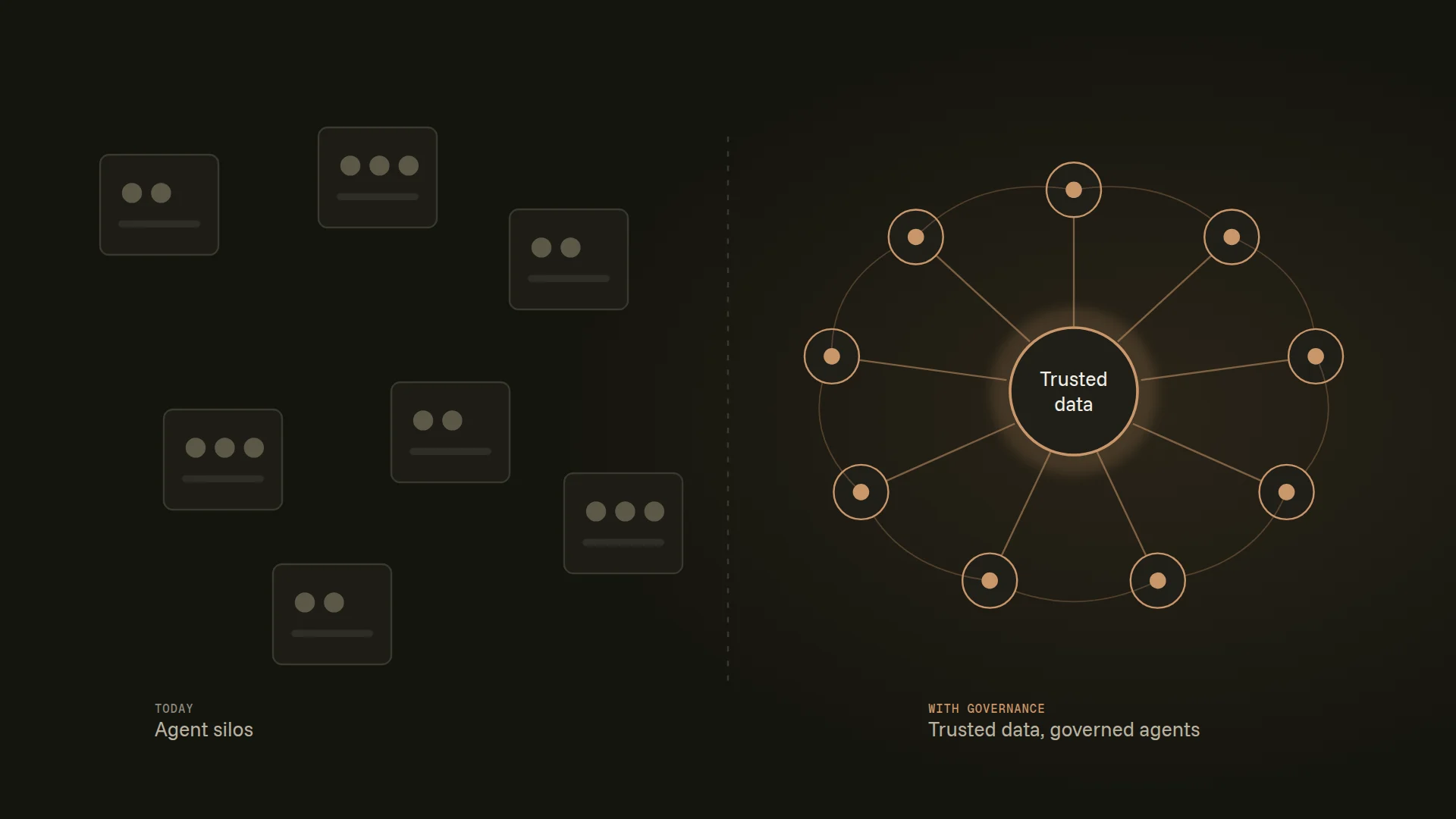
Today, most organizations already run multi-agent systems. Agents resolve customer queries, run operations workflows and make decisions on the manufacturing floor. But each team builds its own agent, wires it to its own APIs and lets it read whatever data it can reach.
Left alone, we will end up with agent silos: hundreds of agents nobody can find, reuse or explain.
Quick check: can you answer these four questions about your agents today?
- Which APIs is each agent allowed to call, and under whose identity?
- What data is it reading, and is it the trusted version?
- Why did it make its last decision, and could you prove it to an auditor?
- Could another team reuse it tomorrow, or would they build their own?
If any answer was “not sure”, keep reading. That is exactly the gap Informatica and MuleSoft close together.
An AI agent is like a new intern
An AI agent on day one is a bright new intern: capable, fast, and missing context. It does not know your customers, your rules, or which of your five “customer” tables is the real one. Give it siloed data and loose permissions, and you do not get intelligence. You compound the problem.
Trusted data is still the foundation. But going forward, governing the agents themselves matters just as much. One platform governs what agents know. The other governs how they connect and act.
Informatica vs MuleSoft: who does what
Salesforce frames the journey as Unlock → Trust → Activate: connect your data, make it trustworthy, then let agents act on it. Informatica and MuleSoft each own a different part of that chain.
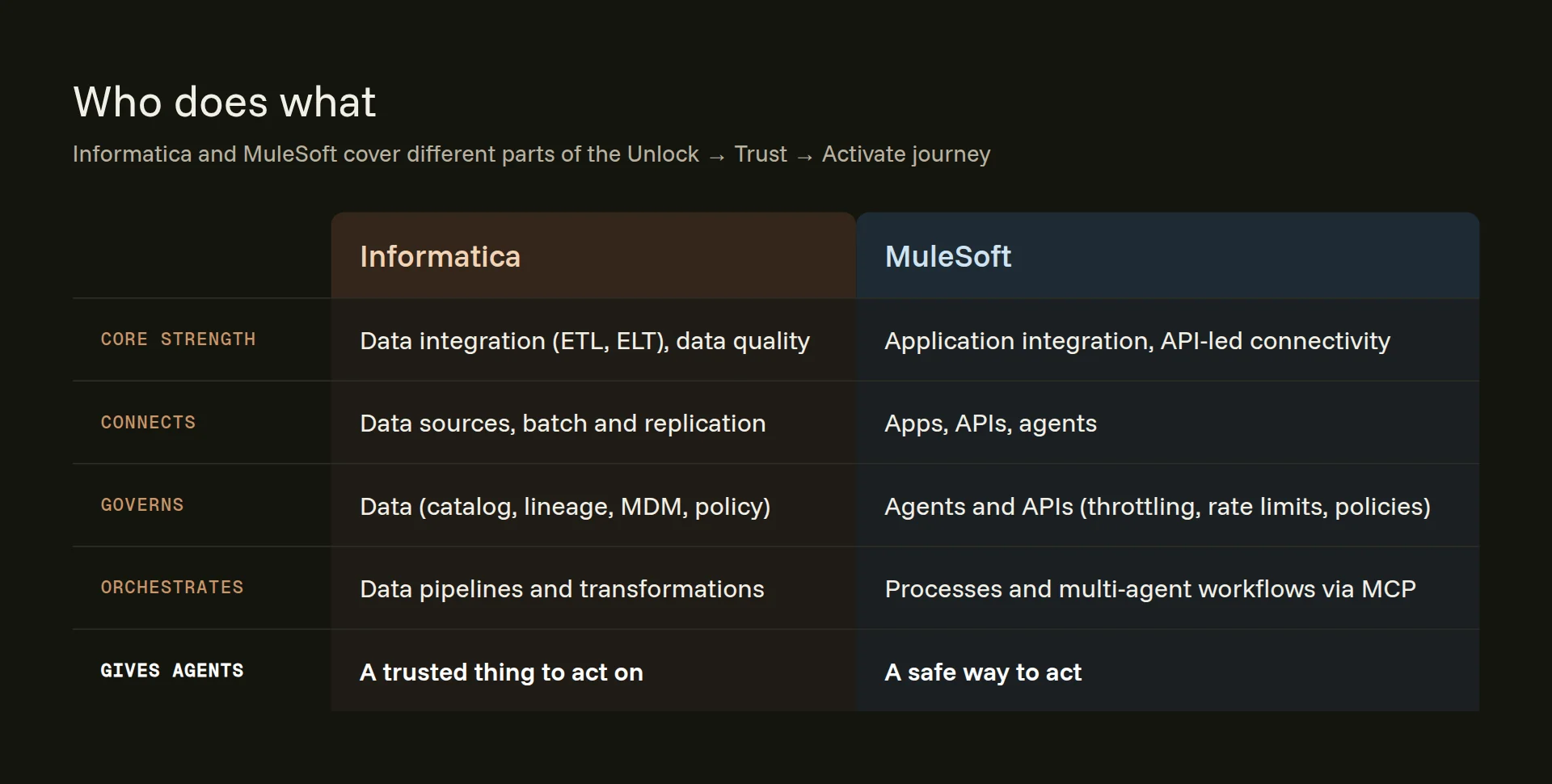
Informatica: what agents know
Informatica makes sure the data reaching an agent is accurate, governed and explainable. Its data catalog and lineage show where every field came from. Data quality rules and policies decide what is fit to use. And MDM delivers the golden record: one cleansed, validated view of each customer, product or supplier. Through Informatica MCP servers and the MDM connector, agents can reach that trusted data directly instead of guessing.
MuleSoft Agent Fabric: how agents act
Agent Fabric is MuleSoft’s control plane for AI agents, built in five layers:
- Enterprise accountability: makes your existing systems, data and AI actions usable inside agentic workflows.
- Discover: Agent Registry and Agent Scanners find and catalog every agent and its actions, so teams reuse proven agents instead of rebuilding them.
- Govern: Omni Gateway and Trusted Agent Identity apply consistent security and compliance to every agent, tool and model.
- Orchestrate: Agent Broker connects multiple agents and tools with intelligent routing.
- Observe: Agent Visualizer shows how agents relate, interact and perform.
MuleSoft’s Context Catalog adds one place to manage AI services and data assets together.
See it in action: one refund request
A customer asks a service agent for a refund on a damaged order. Here is what happens when both platforms are in place:
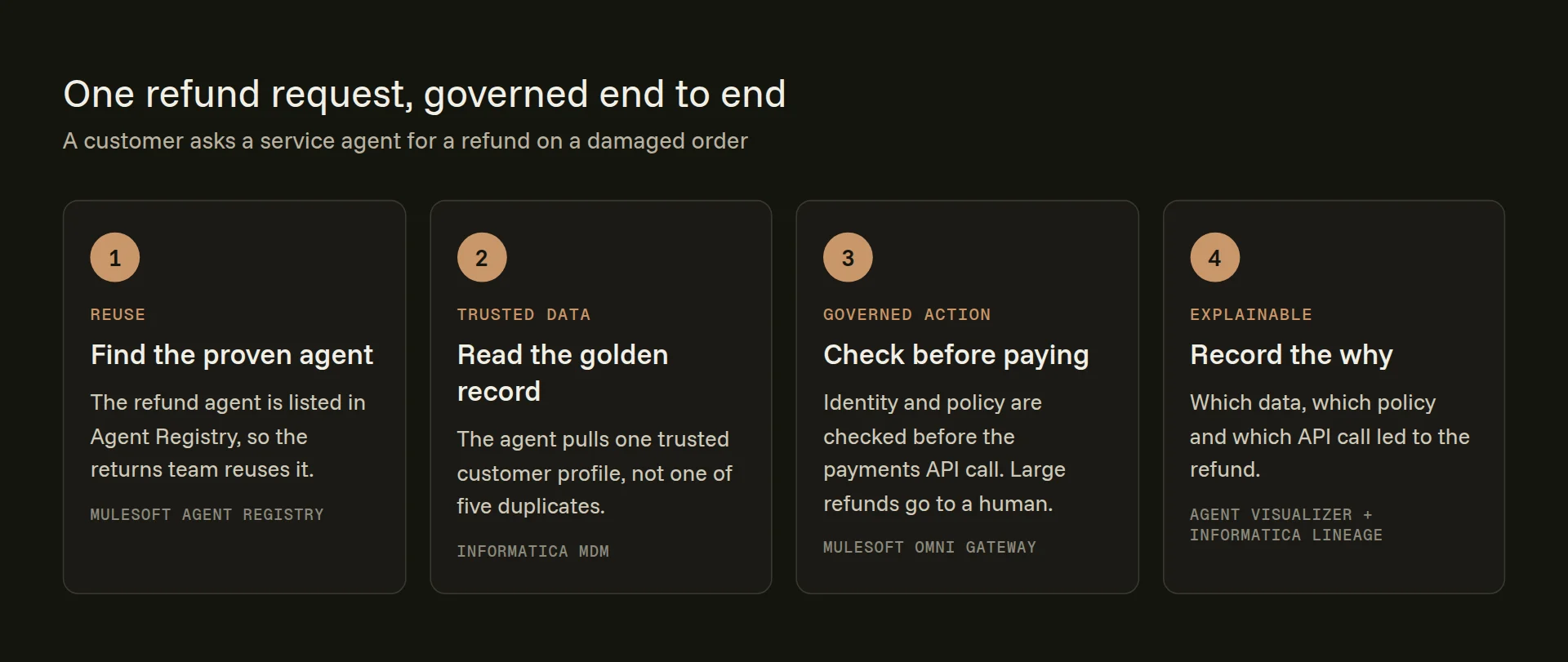
- Reuse: the refund agent is listed in Agent Registry, so the returns team uses the same proven agent instead of building a second one.
- Trusted data: the agent pulls the customer’s golden record through Informatica MDM, not one of five duplicate profiles.
- Governed action: before it calls the payments API, Omni Gateway checks the agent’s identity and policy. Refunds above a set limit go to a human.
- Explainable decision: Agent Visualizer and Informatica lineage record which data, which policy and which API call led to the refund.
Four questions from the start of this article, four clear answers.
Where Informatica and MuleSoft meet
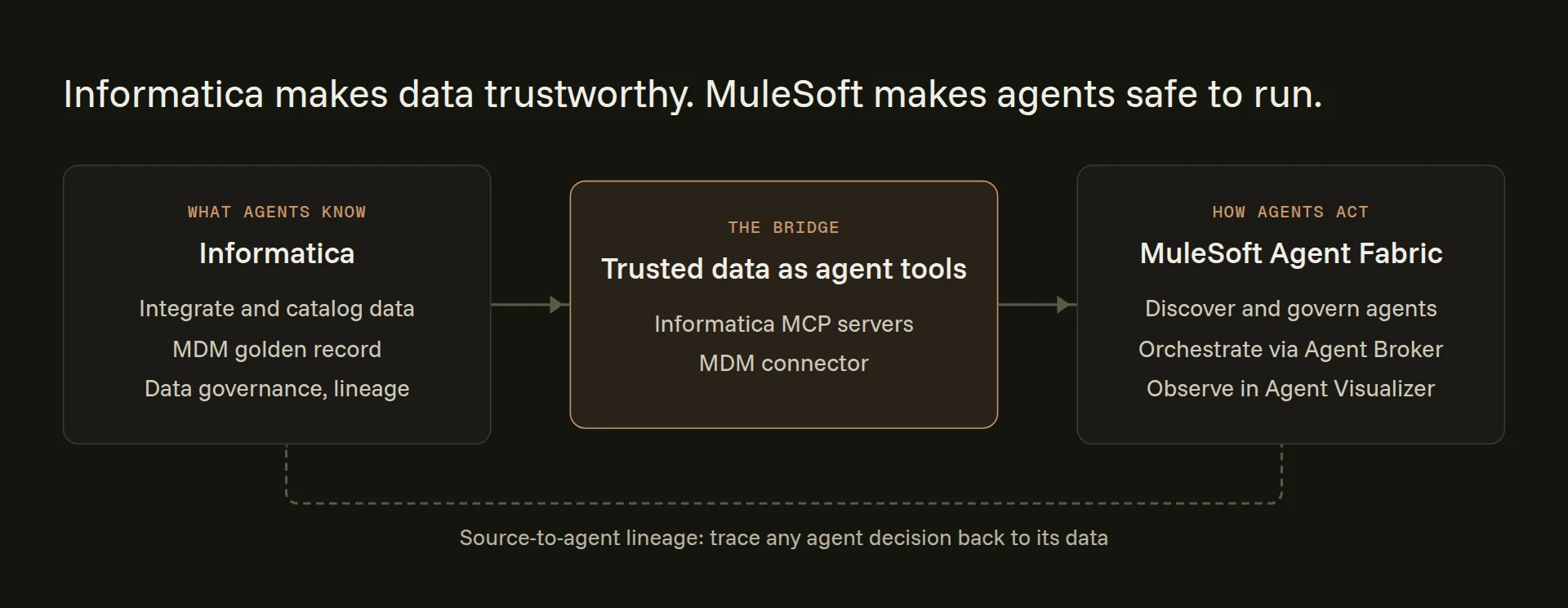
- Source-to-agent lineage. Agent Visualizer plus Informatica data lineage lets you trace any agent decision back to its source. That is explainability you can show an auditor.
- Trusted agent workflows. Agent governance plus MDM data governance means AI acts on a single source of truth, not whichever table it found first.
Together they close two gaps at once. Informatica breaks down data silos and secures the data. MuleSoft breaks down agent silos and keeps agents within their intended boundaries.
The takeaway
Agents are only as good as the context they act on, and only as safe as the controls around them. Informatica supplies the context. MuleSoft supplies the controls.
We spent the last decade breaking down data silos. The next few years are about making sure we do not build agent silos in their place. Apart, each platform solves half the problem. Together, they turn the eager intern into a trusted colleague.
How Incept helps
At Incept Data Solutions, we help our customers get ready for the agentic enterprise, and make the most of it once they are there. We bring trusted data and governed agents together, because we understand what it takes for agents to make decisions a business can stand behind.
Planning your first agents, or trying to bring order to the ones you already have? Talk to the Incept team.
Over to you
Which is your organization’s bigger gap today: trusted data or governed agents? Tell us. We read every message.